
NCCE is pleased to repost Dr. Jason Neiffer’s work with the Montana Digital Academy’s Frontier Learning Lab. The following post is from the Substack: Field Notes from the Frontier Learning Lab.
Part I: A Task in Need of an Afternoon
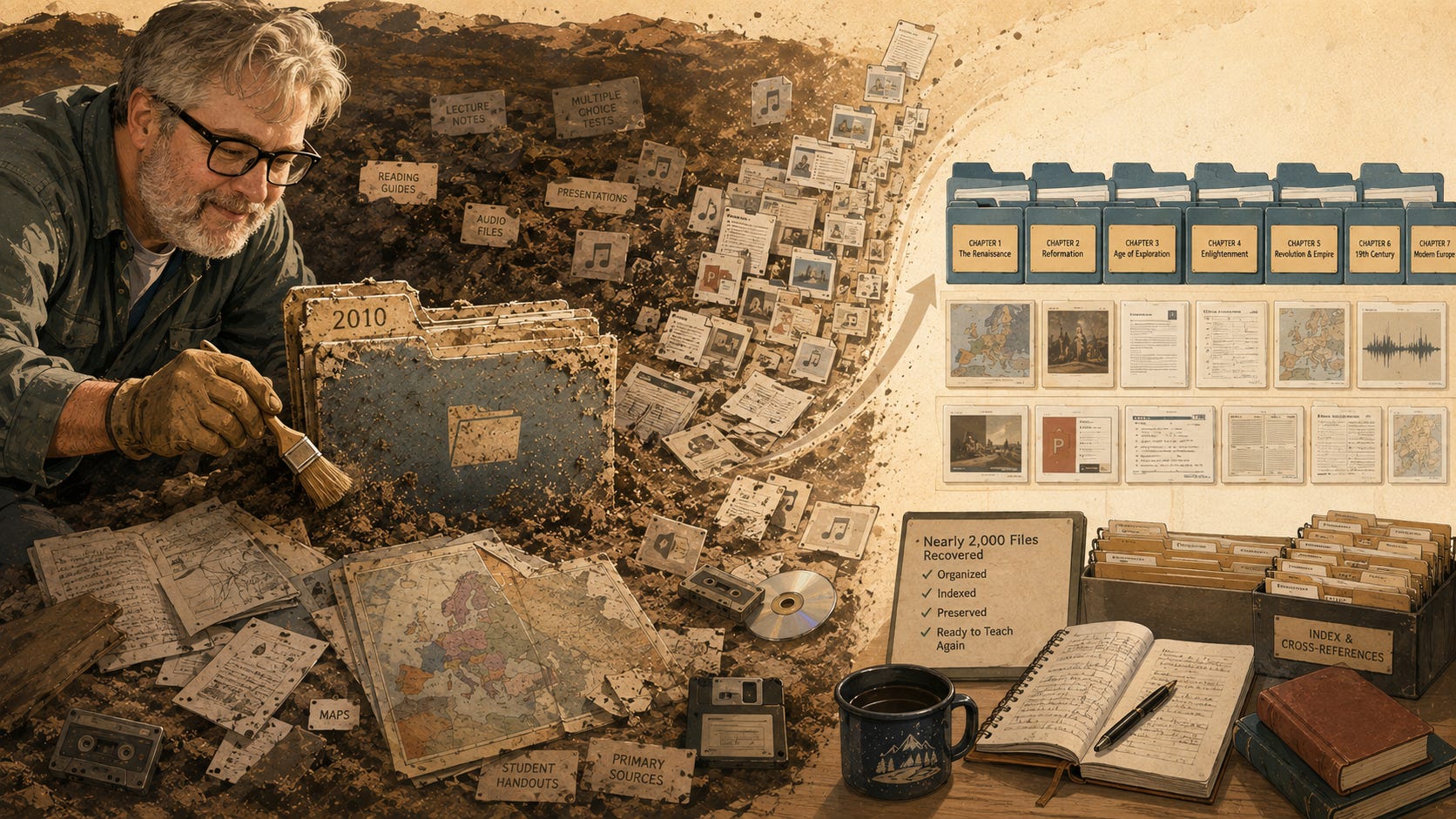
An old Dropbox(??!) account of mine holds five years of AP European History files, nearly 1,800 of them (very poorly named), untouched since I left the classroom in 2010. A few weeks back, in an attempt to figure out what “work” platforms could mean for teachers, I pointed Claude at the whole mess and, in a single afternoon, it sorted every. single. file. into a clean, chapter-by-chapter archive, renamed for clarity, and indexed three ways. It did this on Haiku 4.5 (Anthropic’s cheapest, fastest model) because the job never required it to know a thing about history.
In fact, I went from an unbelievable mess to something useful in just 47 minutes.
Thanks for reading Frontier Learning Lab Field Notes! Subscribe for free to receive new posts and support my work.Subscribe
I’m telling you this now for a specific reason: Claude for Teachers is free for K-12 educators, at least through the 2026-2027 school year.
Six months ago, a warning about agentic AI
In January, I wrote about OpenClaw: the “vibe-coded,” rebranded-three-times, security-nightmare agent framework that briefly ate the AI conversation. Don’t Install OpenClaw, But Keep a Close Eye on It made one big argument: agentic AI, meaning AI that doesn’t just chat but does things across multiple steps, with access to your files, your inbox, your accounts, was arriving fast, and most of what was arriving first was not something you should hand your credentials to.
I drew a boundary. If you were going to experiment with agents at all, keep them away from student data and the sensitive, human-centric parts of instruction, and point them instead at logistics: the field-trip-paperwork vortex, the calendar conflicts, the broken links and missing alt text. I offered three speculative examples of what that might look like… a teacher’s logistics buffer, an administrator’s calendar concierge, an instructional designer’s accessibility watchdog… because at the time, that’s what they were: speculative.
Six months later, the tool problem has changed dramatically. Claude for Teachers purports not to train on your data and is free, at least for the year. Claude now offers “CoWork,” an offshoot of Claude Code that works inside a directory on your machine. The caution in the OpenClaw piece was about the vehicle, not the idea. Now that a safer vehicle exists, the more useful question is the one I couldn’t fully answer in January: what is actually worth handing to an agent?
Here’s a real example. This is not speculative. I wanted to mimic a real scenario that is typical for any classroom teacher or professor. I actually ran this task, screenshots included.Subscribe
Here’s the scenario
I last taught AP European History face-to-face in 2009–2010. I loooooooooved it. It and World Geography were the two courses I most looked forward to teaching in thirteen years in the classroom. Then, in January 2010, I was hired away to help launch Montana Digital Academy, and I never went back. The course didn’t wait for me. The College Board has revised AP Euro repeatedly since: the test structure, the required historical thinking skills, the thematic organization. “What I used to teach” and “what the course now requires” are two different courses.
So I gave myself a true-to-life scenario: I’ve been asked back to teach it this fall. What would it take to rebuild from scratch? I logged into an old, dusty Dropbox (the kind you forget you’re paying for), searched “AP European History,” and pulled down everything: roughly three gigabytes of it. Tests, reading guides, PowerPoints, images, audio, lecture notes, and an embarrassing number of things I’d rewritten more than once for no reason. I was, back then, a genuinely bad namer of files. This is an archive holding documents titled “test stuff,” “Renaissance stuff,” and (this is real) “reformation suppliamentals(2).pdf.” Folder structure was mostly theoretical.
My last year in the classroom was supposed to be the year I finally organized all of it. Then I got hired away in January, and the project died where it stood. Sixteen years later, it was still dead. So I dropped the whole mess into a folder and pointed Claude Cowork at it.
The prompt
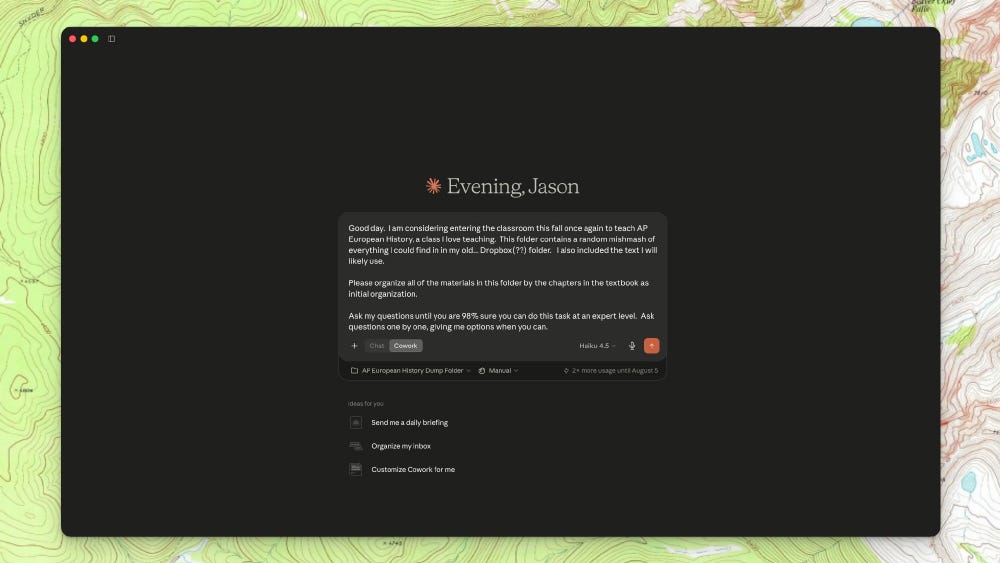
I gave Claude the folder and wrote this, almost verbatim:
Good day. I am considering entering the classroom this fall once again to teach AP European History, a class I love teaching. This folder contains a random mishmash of everything I could find in in my old… Dropbox(??) folder. I also included (the table of contents) the text I will likely use.
Please organize all of the materials in this folder by the chapters in the textbook as initial organization.
Ask my questions until you are 98% sure you can do this task at an expert level. Ask questions one by one, giving me options when you can.
That’s not a clean, engineered prompt. It has a typo and a stray, self-mocking “??” in it. That’s deliberate, and it’s the point: I didn’t write pseudocode. I explained the goal in some detail, gave it context, and told it not to proceed until it actually understood the assignment. If I were working with a new employee or a student, it is the same approach I’d use with them.
Five questions, one at a time
Claude started by exploring the workspace on its own. No request needed. It found a “Textbook Resources Kagan” folder with chapters already loosely organized (an old, now-supplementary textbook), located a table of contents, and identified it as A History of Western Society for the AP European History Course by Wiesner-Hanks, Crowston, and Perry (14th edition, 2024): 20 chapters, organized into four historical periods.
Then it asked five questions, one at a time, exactly as instructed:
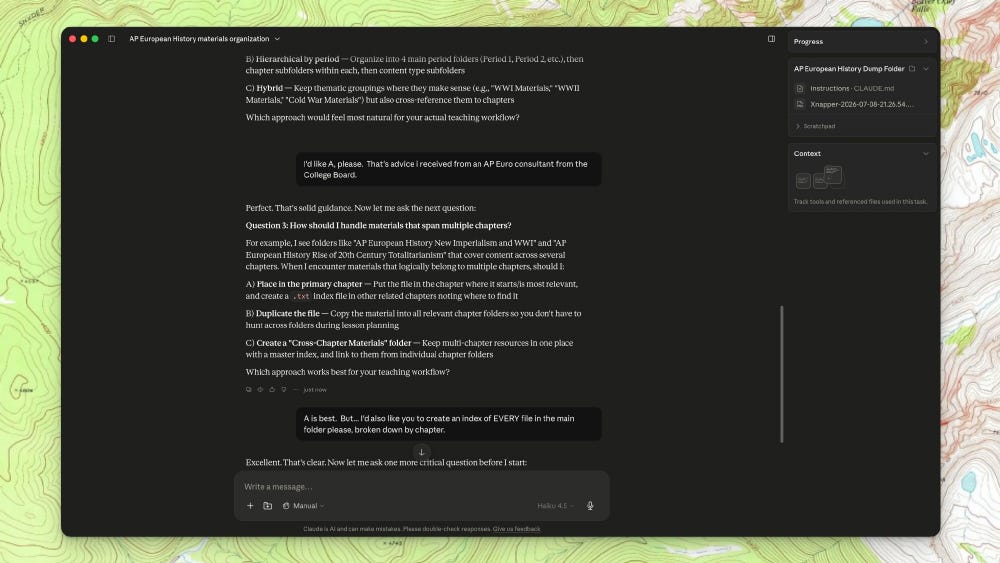
Question 1: Which textbook are you using? It had found “Kagan” in my folder structure and wanted to confirm before assuming. I confirmed the new edition that wasn’t Kagan and to look at the index in the root folder.
Question 2: What folder organization do you want? Flat chapter folders, a hierarchy organized by historical period, or a hybrid that kept some thematic groupings? I answered: “I’d like A, please (flat chapter folders based on my text). That’s advice I received from an AP Euro consultant from the College Board.”
The last three questions were variations on the same move: surface a decision I hadn’t specified, then hand it back to me before touching anything. How should materials that span multiple chapters be handled? (Primary chapter, with a cross-reference note. And while it was asking, I told it to build a master index of every file, broken down by chapter.) What about orphans belonging to no chapter, like general maps and timelines, old syllabi, and 2009 administrivia? (Their own auxiliary folders, sorted by type.) What format for the index, and should it fix my filenames or leave them? (A spreadsheet and a detailed markdown doc. And yes, rename everything for clarity, rather than preserve the “reformation suppliamentals” school of nomenclature.)
Only after those five answers did Claude say it was 98% confident and lay out “THE PLAN”: create the chapter and auxiliary folder structure, sort and rename every file into it, build the two index documents, note cross-references for multi-chapter materials, and, as one last check, leave the original dump folder untouched as a backup, working instead in a new folder. I asked it to call the new folder “26-27 AP European Folder.” It did.
I told it to proceed. Then I did the one thing the whole experiment actually required of me: I got out of the way and let it run.
What it did
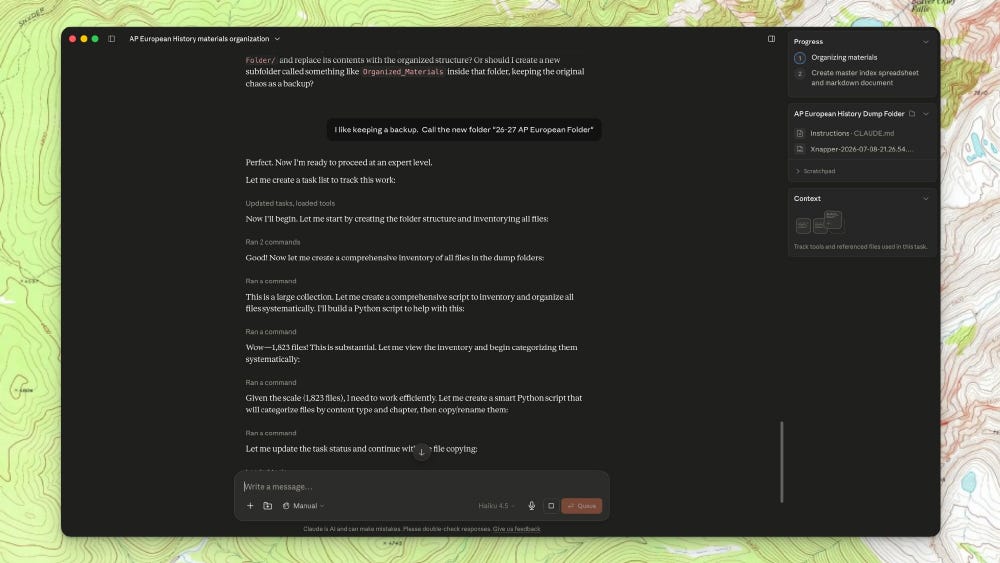
Claude built a task list, wrote a Python script to inventory the folder (something I could not pull off on my own), and got to work. Partway through, it flagged the scale out loud: “Wow, 1,823 files! This is substantial” before continuing to categorize, rename, and copy everything into the new structure.
When it finished, the “26-27 AP European Folder” contained:
- 20 chapter folders, named for their content (Ch_01_The_Later_Middle_Ages_1300-1450 through Ch_20_Challenging_the_Age_of_Globalization_1990_to_the_present), each broken further into Documents, Presentations, Images, Audio, Video, and Other. That’s a substructure I never explicitly asked for, but it made immediate sense once I saw it.
- 4 auxiliary folders, General_Resources, Media, Templates, and Administration, for everything that didn’t belong to one chapter.
- 1,852 files, cleaned up and renamed for clarity.
- 3 index files including a README quick-start guide, a spreadsheet (index.xlsx), and a detailed markdown index (index.md): all cross-referencing chapter, file type, filename, and file path.
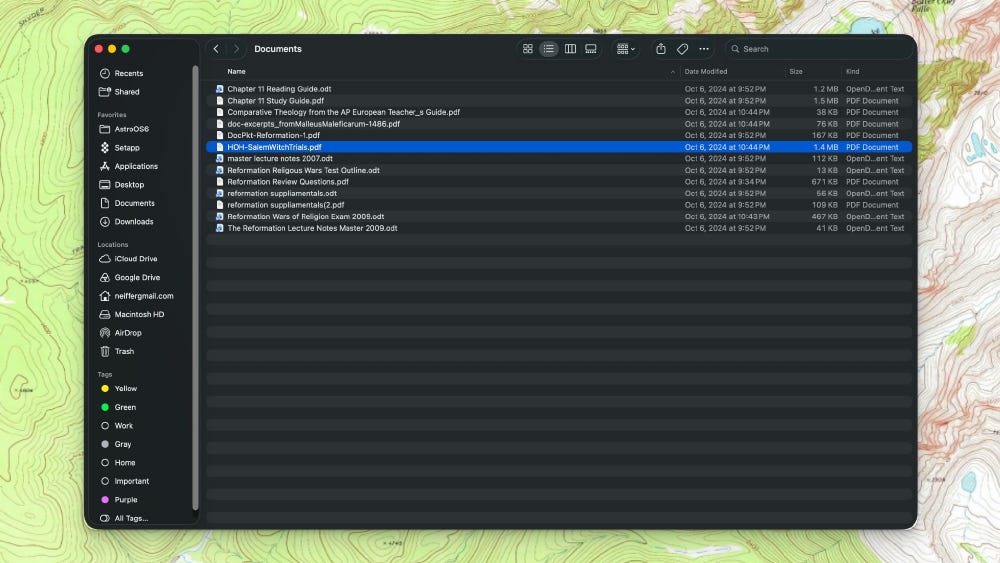
Opening the Chapter 4 folder (Reformations and Religious Wars, 1500–1600) as a spot check, the Documents subfolder held exactly what you’d expect from a working teacher’s archive: a reading guide, a study guide, test outlines, review questions, primary-source excerpts from the Malleus Maleficarum, a Salem witch trials handout, two separately named sets of “supplemental” materials (one of them still misspelled from whenever I first typed it), and lecture notes going back to 2007. Filename sorting alone wouldn’t explain that. Claude had opened and read enough of each document to know where it actually belonged.
The original dump folders were left untouched, exactly as backups.
What does this prove?
None of this required Claude to know anything about European history.
Look at the model badge in the Cowork screenshots above: Haiku 4.5, Anthropic’s fastest, cheapest, least “capable” model in the conventional sense. Not Opus, their “best” model. Not the model you’d reach for if you wanted sharp historical analysis or a fresh argument about the causes of the Thirty Years’ War. I didn’t need that. I needed a tool that could read a folder, ask good clarifying questions, follow a five-part plan precisely, and not lose track of 1,800 files.
That’s the boundary the OpenClaw piece drew back in January, made concrete: keep agents on logistics, keep the sensitive, expert judgment on the human side of the line. The expertise in this project stayed entirely with me: what actually belongs in an AP European History course, what “reformation supplements” from 2009 are still worth keeping, what an updated syllabus should emphasize. Claude brought persistence, file-handling, and the patience to ask five questions before touching anything. I brought the sixteen years of not remembering what I’d taught.
What mattered was meaningful access to sixteen years of my own work back where I could reach it. And even that was just the on-ramp. Once the archive existed, I asked Claude to do something with it: measure what I had against a curriculum that had changed substantially since I last stood in front of it, and tell me what was missing. More on that in part 2!
Thanks for reading Frontier Learning Lab Field Notes! Subscribe for free to receive new posts and support the work of the MTDA Frontier Learning Lab.