
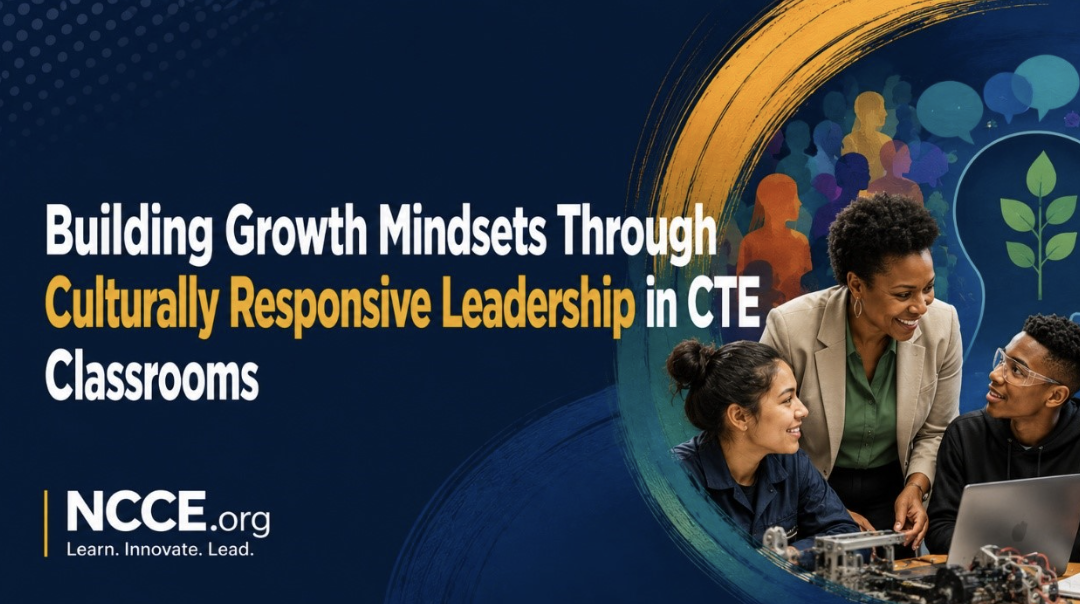
Career and Technical Education (CTE) has always been about preparing students for success beyond the classroom. Today’s workforce, however, requires more than technical proficiency. Students need adaptability, confidence, collaboration skills, and the ability to learn continuously in diverse environments.
That is why culturally responsive leadership and a growth mindset are such powerful partners.
At NCCE, leadership practices are grounded in culturally responsive practices and decisions that support a growth mindset for all. These principles create learning environments where every student feels valued, challenged, and empowered to grow— regardless of their starting point.
For CTE educators, these ideas are not separate initiatives. They can become part of everyday instruction, classroom culture, and leadership decisions.
Why Culture and Growth Mindset Belong Together
A growth mindset is the belief that abilities and intelligence can be developed through effort, effective strategies, feedback, and persistence. Students with a growth mindset are more likely to embrace challenges, recover from setbacks, and continue learning.
Culturally responsive teaching complements this mindset by recognizing and valuing students’ cultural identities, lived experiences, languages, and strengths. Rather than expecting students to adapt to one instructional model, educators intentionally design learning experiences that reflect and honor the diversity within their classrooms. Together, these approaches help students hear a powerful message:
“You belong here. Your experiences matter. And you are capable of continued growth.”
For CTE programs that serve students from many backgrounds and career interests, this combination builds both technical skills and confidence.
A Practical Framework: The GROW Model
One-way educators can intentionally connect culturally responsive practices with a growth mindset through the GROW framework.
G — Get to Know Students
Effective leadership begins with relationships.
Students engage more deeply when they know their teacher values who they are—not just what they produce.
Simple strategies include:
- Learning how students prefer to be addressed.
- Incorporating student interests into projects.
- Connecting career examples to multiple cultures and industries.
- Inviting students to share community knowledge and personal experiences.
For example, an automotive technology teacher might ask students to investigate transportation challenges within their own communities before designing maintenance or repair solutions.
Students see that their perspectives are assets rather than obstacles.
R — Reflect on Instructional Decisions
Culturally responsive leadership requires continuous reflection.
Ask questions such as:
- Who participates most often?
- Whose voices are missing?
- Do assessments allow students multiple ways to demonstrate learning?
- Are classroom examples representative of diverse professionals and communities?
Reflection also means examining classroom routines.
For example, instead of assuming all students have equal access to technology outside school, a teacher may provide class time for digital assignments or offer multiple pathways for completing projects.
Small adjustments often create significant increases in student engagement.
O — Offer Productive Feedback
Feedback shapes mindset.
Instead of praising students solely for being “smart” or “naturally talented,” focus feedback on:
- Effort
- Strategy
- Revision
- Collaboration
- Problem-solving
- Persistence
Compare these examples:
Instead of:
“You’re a natural welder.”
Try:
“Your practice with bead consistency is paying off. I noticed how you adjusted your technique after reviewing yesterday’s feedback.”
This reinforces the idea that improvement comes through learning and practice.
W — Widen Opportunities for Success
Students thrive when they see multiple pathways to achievement.
This includes:
- Flexible project choices
- Student leadership opportunities
- Industry mentors from diverse backgrounds
- Collaborative problem-solving
- Authentic workplace scenarios
- When students can connect learning to their identities and future goals, motivation naturally increases.
Classroom Examples Across CTE Programs
Every CTE classroom offers opportunities to blend culturally responsive practices with growth mindset strategies.
Health Sciences
Students interview family or community members about healthcare experiences and compare how cultural perspectives influence communication between patients and providers.
Reflection activities help students recognize that effective healthcare professionals must be skilled communicators as well as technical experts.
Information Technology
Students design apps or websites that address challenges identified within their own communities.
Throughout the design process, teachers celebrate iteration, testing, and revision rather than expecting perfect first attempts.
Culinary Arts
Students research recipes that reflect their cultural backgrounds while applying industry-standard culinary techniques.
Class discussions emphasize that diverse food traditions strengthen creativity and innovation within the culinary profession.
Construction and Manufacturing
Project teams rotate leadership roles, so every student practices communication, planning, and collaboration.
Teachers intentionally recognize growth in teamwork, safety habits, and problem-solving—not just the finished product.
Leadership Beyond the Classroom
Culturally responsive leadership extends beyond daily lessons.
Department leaders, instructional coaches, and administrators can reinforce these practices by asking:
- Whose perspectives are represented in curriculum planning?
- Are professional learning opportunities accessible to all staff?
- Do classroom observations include evidence of student voice and belonging?
- Are families welcomed as partners in learning?
Strong leadership creates systems where continuous improvement becomes the expectation for everyone—not only students.
When educators model curiosity, reflection, and lifelong learning, students are more likely to adopt those same habits.
Measuring Growth Differently
Traditional grading often highlights final performance.
Growth-minded classrooms also recognize progress.
Consider documenting:
- Skill development over time
- Reflection journals
- Portfolio revisions
- Peer collaboration
- Professional communication
- Career readiness skills
These measures more accurately reflect how learning occurs in both school and the workplace.
Employers consistently value employees who learn from feedback, adapt to change, and collaborate effectively. CTE classrooms can intentionally cultivate those habits.
Small Changes, Lasting Impact
Creating culturally responsive, growth-focused classrooms does not require a complete redesign of existing curriculum.
Instead, educators can begin with manageable shifts:
- Replace deficit-based language with asset-based language.
- Include diverse industry professionals in classroom examples.
- Build regular opportunities for student reflection.
- Normalize revision as part of learning.
- Celebrate improvement alongside achievement.
- Encourage students to learn from one another’s experiences.
Over time, these practices become part of classroom culture.
Students begin to expect that mistakes are opportunities, diverse perspectives strengthen learning, and every individual has the capacity to grow.
Looking Ahead
The future workforce demands technical expertise, adaptability, empathy, and collaboration. CTE educators are uniquely positioned to develop all of these qualities.
By leading through culturally responsive practices and fostering a growth mindset, educators create classrooms where every learner is challenged, supported, and empowered to succeed.
At NCCE, these leadership principles reflect a commitment to helping educators build inclusive learning environments where all students can thrive. When students feel seen, respected, and capable of growth, they are better prepared—not only for careers, but for lifelong learning and leadership.
References
Dweck, C. S. (2006). Mindset: The New Psychology of Success. Random House.
Hammond, Z. (2015). Culturally Responsive Teaching and the Brain. Corwin.
Gay, G. (2018). Culturally Responsive Teaching: Theory, Research, and Practice (3rd ed.). Teachers College Press.
CAST. Universal Design for Learning (UDL) Guidelines. HTTPs://udlguidelines.cast.org/

Christopher Glascock
Title: Business Technology Teacher/Student Programs & Activities Leadership District: Idaho Falls School District 91
Stay in touch with NCCE by connecting with us! https://ncce.org/” at the end of the article.