

Guest Blog By: Natalie Hanni, Account Executive, MagicSchool.ai
AI is now part of how students learn, explore, and communicate, both inside and outside the classroom. And just as digital citizenship shaped the last decade of learning, AI literacy is becoming a foundational skill for students in 2026 and beyond. Students need guidance to use these tools responsibly, and teachers are especially well positioned to provide it.
The good news is that AI literacy doesn’t require overhauling your curriculum. It grows through small, everyday moments: questioning whether information is accurate, refining a prompt, or reflecting on when and why they used an AI tool. When districts create safe environments and shared expectations, those moments become even more powerful.
Here are five approaches we’ve seen help students build AI literacy with confidence.
1. Model responsible AI use during everyday lessons
Students learn a lot from watching how you use AI in real time. When you use a tool to differentiate reading materials or generate discussion questions, talk to them about it. Explain how and why you used AI, and where you chose to create something on your own.
“I’m using AI to create three versions of this article. One at grade level, one simplified, and one more complex so everyone can understand the ideas.”
Thinking aloud helps students see that your judgment guides the work and that AI is a partner in learning, not a replacement for it.
For districts: Prioritize professional development that focuses on how to model AI instructionally, not just how to use the tools. Your partner can help build this into existing PD.
2. Teach students how to ask better questions
Learning how to ask strong questions is a foundational skill, and that includes knowing how to use AI in ways that deepen understanding. The goal is helping students craft prompts that move their learning forward.
Show them how a vague prompt like “Tell me about World War II” differs from a more focused one like “Explain three key turning points in World War II and why each mattered.” Let them practice in groups, refine their questions together, and even run a friendly competition to see which prompts generate the most useful results.
For districts: Provide shared lesson templates for teaching prompting skills across grade levels, so educators have a consistent starting point instead of building from scratch.
3. Build credibility checks into class routines
AI can sound confident even when it’s wrong. MagicSchool flags this for students every time they log in, but regular classroom routines are where a fact-checking habit truly forms. When students use AI, ask them to verify key claims by citing at least one external source and note where the AI’s output raised questions or needed correction.
These checks don’t have to be complicated. The small act of pausing to confirm information builds critical evaluation skills that stay with students for life.
For districts: Set district-wide expectations for disclosing and verifying AI use, and choose tools that support those habits. Position these guidelines as part of learning, not just rules to follow.
4. Give students a safe place to practice using AI
Students are already exploring AI on platforms like ChatGPT and Snapchat. Without teacher-led experiences in school, they’re learning in environments that may not prioritize safety or accuracy.
Create supervised opportunities where students can try safe, district-approved tools, compare what they discover, and reflect on their choices. Teachers across the Pacific Northwest are already doing this in creative ways. In one classroom, students used AI chatbots to “interview” historical figures from the Industrial Revolution, building content knowledge and AI literacy at the same time.
Visibility into student use is essential.
Karen H.
Director of Learning Management Systems for Everett Public Schools in WashingtonHer point highlights why districts should provide AI tools with built-in safety features and teacher monitoring. When educators can see how students are using AI, they can spot creative exploration, address potential misuses early, and turn each interaction into a learning opportunity.
For districts: Provide vetted AI tools for students with built-in safety features and teacher monitoring capabilities.
5. Teach students to reflect on how they use AI
AI literacy also means helping students understand the choices they make when they use these tools. Cognitive offload is easy in the moment, but students need to recognize how it can shape their learning over time.
Build simple self-reflection into assignments that involve AI. After using a tool for writing support, have students describe what the AI contributed, what they created on their own, and where they chose to rely on the tool. Could they have completed parts of the task independently? Was the offload necessary? What did they learn from comparing their work with the AI’s?
These reflections reinforce that AI is a learning partner, not a shortcut.
For districts: Consider implementing student pledges or contracts for responsible AI use. These can spark meaningful conversations about values, decision-making, and long-term habits.
Schools across the Pacific Northwest are showing what it looks like to integrate AI thoughtfully. They recognize that while AI is already part of students’ lives, schools can shape how students understand it, question it, and use it well.
By modeling responsible use, teaching better prompts, building credibility checks, creating safe spaces for practice, and encouraging reflection, educators are helping students become confident, critical, and responsible AI users, now and in the future.
Chat with us during Live from NCCE
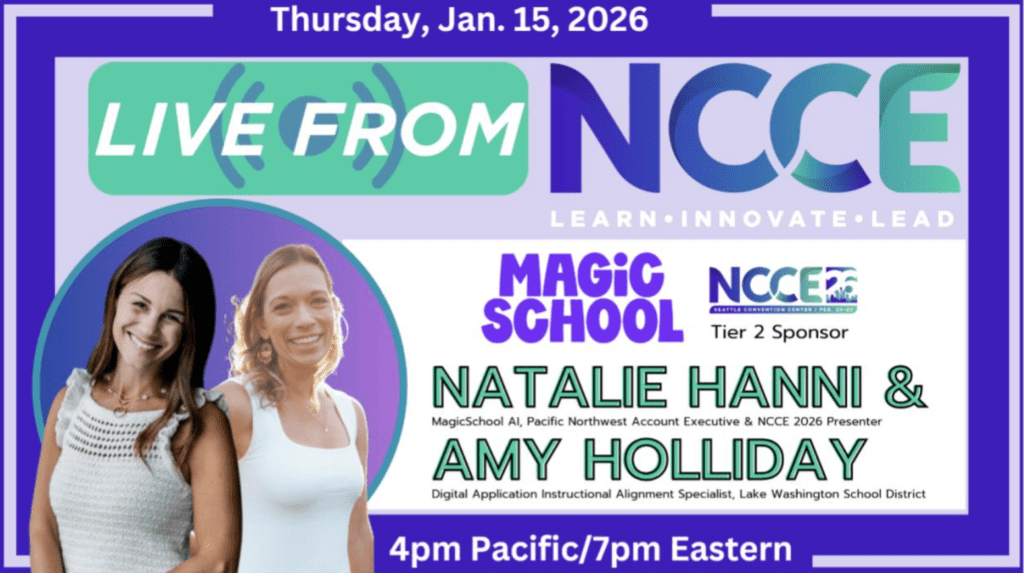
Click HERE to watch Live from NCCE on Thursday, January 15, 2026 at 4 pm PACIFIC.
Magic School will be at NCCE26
CTE SUMMIT: CONNECTING CTE LEARNING, INNOVATION, AND INDUSTRY
Wednesday, February 25, 8:00 am–12:00 pm
AND
Thursday, February 26, 12:00 pm–12:50 pm