By Jessica Schuler
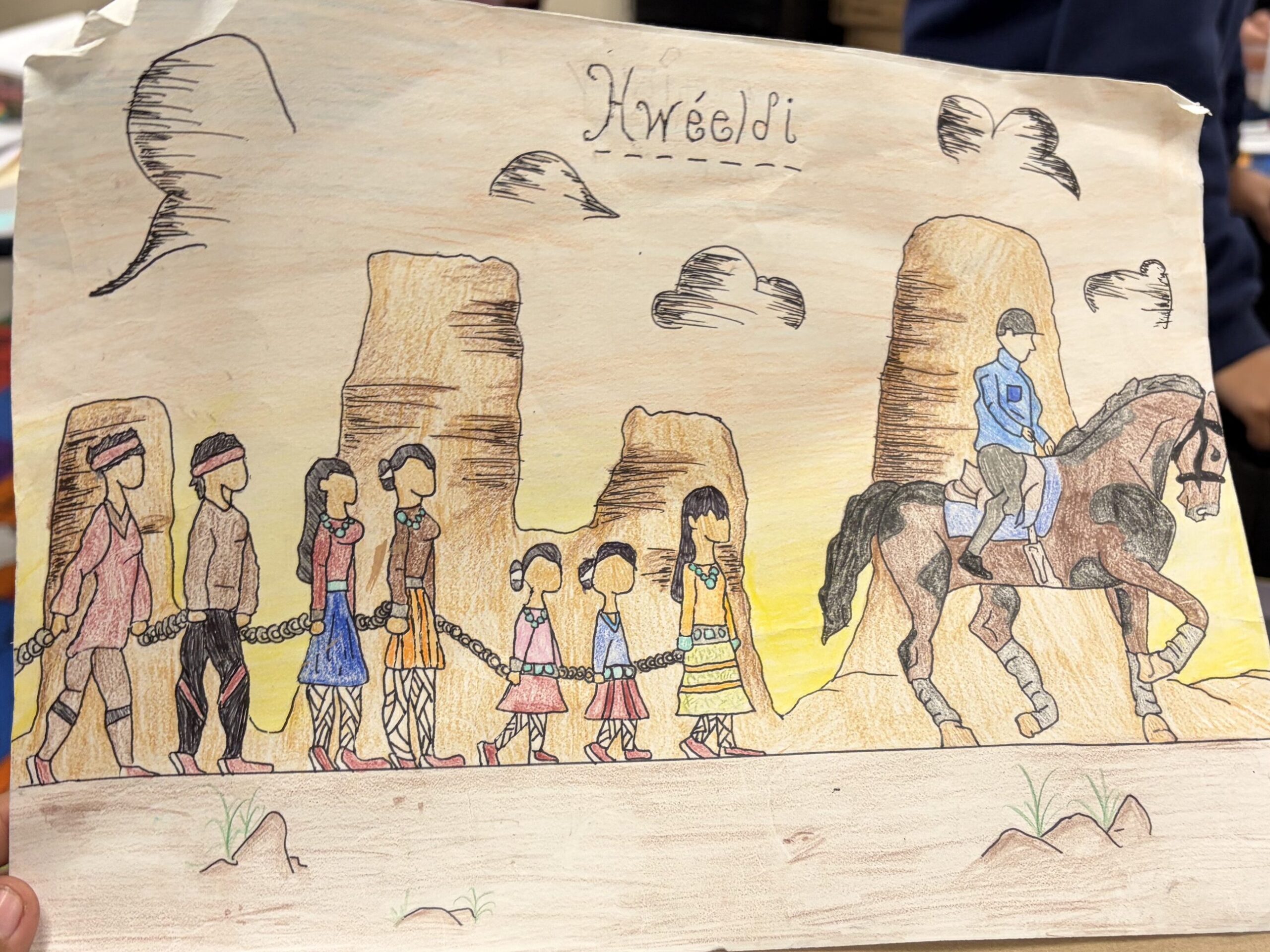
In a fifth-grade classroom at Jefferson Elementary School in Gallup, New Mexico, students are exploring Spider Rock and Canyon de Chelly National Monument—places deeply connected to the Navajo story of Spider Woman, a revered figure who, according to tradition, gifted the Navajo people the essential tools for survival.
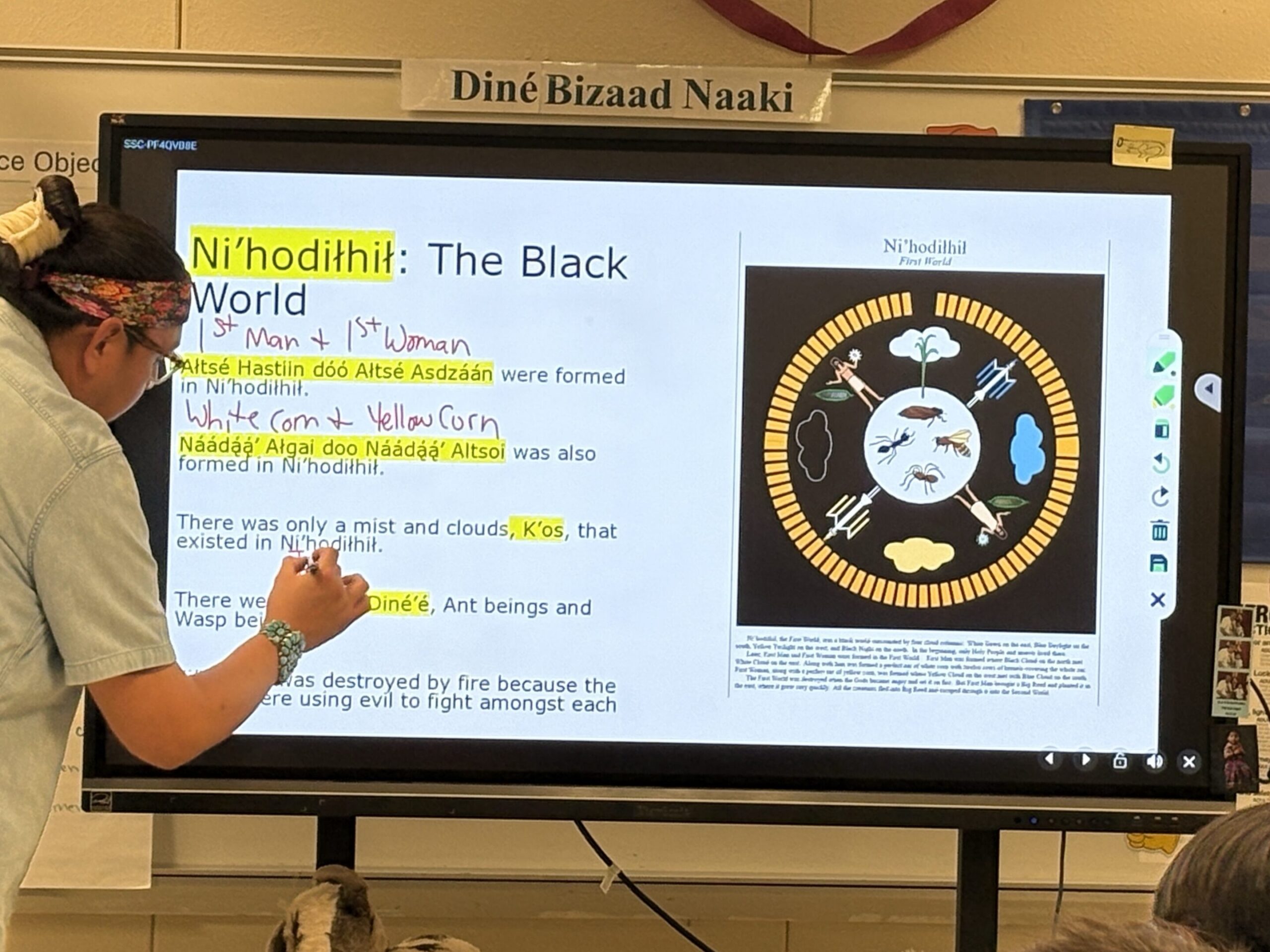
Students work together to unpack the story, discussing their own “special places” and what gives a place meaning in their community. Along the way, they are practicing Diné vocabulary, the language spoken in Navajo Nation, and making connections between traditional stories and their own lives.
Technology serves as a tool for expression and reflection, as some students record their ideas, others create visual responses, and some use Google Earth to explore places throughout Gallup and the surrounding region.
Part of a broader lesson on “Discovering Sacred Places in Our Community,” the goal is to connect language, culture, and place in a way that feels authentic to students. The teacher highlights how Diné culture and environment are “intertwined like a spider web,” which strengthens the lesson’s focus on how stories and places shape who we are.
“I became a Heritage Language and Culture teacher because I truly wanted to help preserve and pass on our language and culture to the next generation,” said Shindera Largo. “Our language carries so much of our history, our identity and our values. I felt a strong responsibility to contribute my knowledge to try to keep those traditions alive.”
For Gallup-McKinley County Schools (GMCS) Heritage Language and Culture (HLC) teachers, preserving language and culture has always been the goal. The challenge has been finding instructional approaches that help students connect those traditions to their own lives.
To help teachers strengthen instruction while preserving cultural authenticity, the district turned to the Northwest Council for Computer Education (NCCE), which has partnered with GMCS for nearly a decade.
New Mexico’s largest and most geographically dispersed district, GMCS serves 32 schools spread across nearly 5,000 square miles in northwestern New Mexico, including communities within and adjacent to Navajo Nation and Zuni Pueblo.
Most HLC teachers are not traditionally trained teachers; most were hired for their language expertise. In addition to having limited formal preparation in pedagogy, many also had very limited technological skills.
“I relied on repetition, translation, and lecture-style instruction because those were the methods I was most familiar with,” Ms. Largo said. “Students participated, but engagement varied, and sometimes it was difficult to measure whether they were truly retaining the language and cultural concepts.”
Enter NCCE. The organization designs and delivers customized professional learning to support educators and elevate student outcomes. NCCE has worked with GMCS on a variety of projects and technology implementations, from districtwide training on Microsoft 365 tools and helping teachers earn their Microsoft educator certification to guidance on creating blended learning environments and using Microsoft Teams as a way to reach students during COVID. This support continues today, years after the pandemic has ended, as NCCE trains new teachers on the basics of utilizing the Microsoft environment with their students.
Another of those projects is supporting the district’s discovery centers—former school libraries that have been transformed into technology-rich learning spaces. NCCE trains the discovery center assistants (DCAs), many of whom previously served in more traditional library roles, to create engaging, student-centered learning experiences that incorporate technology and hands-on exploration.
The support and coaching the DCAs were receiving from NCCE caught the interest of HLC leaders, who requested similar support. “They said, ‘Whatever NCCE is doing for the discovery center assistants, we need it,’” explained Shannon Davenport, NCCE’s chief executive officer. “They couldn’t even open documents to collaborate. They could tell that they needed those basic tech skills.”
Preserving Language Through Modern Learning Tools
For the last two years, NCCE has partnered with HLC teachers across the district—35 teachers and 70 classes of students—to build basic digital literacy and provide pedagogical support through instructional coaching and professional learning to strengthen instructional practices, lesson design, classroom engagement and technology integration.
In the 2025-26 school year, NCCE trainers visited GMCS classrooms five times a year to model instruction and co-teach lessons alongside the HLC teachers.
“Our trainers were presenting the lesson plans, but the HLC teacher was to be the expert in anything Navajo, ensuring cultural and linguistic authenticity,” explained Diane Harrington, a professional learning specialist who works with the district.
The NCCE trainers write the lesson plans, but because they are not well-versed in Navajo culture, collaboration is key to this system—they provide the instructional expertise while the HLC teachers provide the language and cultural expertise.
This year, NCCE trainers modeled five technology-integrated lessons in collaboration with HLC teachers developed to support student preparation for the districtwide social studies fair. Each lesson was aligned with both Navajo and New Mexico social studies standards and engaged students in creating digital artifacts and curating an ongoing digital portfolio.

“Our goal was to meaningfully integrate technology into Navajo language classes for both instructional delivery and student engagement,” Diane continued, adding that students submitted their portfolios through Microsoft Teams, which enabled both teachers and trainers to monitor progress and provide timely feedback throughout the project.
“Before working with NCCE, one of the biggest challenges was finding effective ways to engage students while also preserving the integrity of our Heritage Language and Culture teachings,” Ms. Largo said. “Many of us come into teaching with deep cultural knowledge, but not always with formal training on instructional strategies, lesson design or even classroom management. NCCE provided guidance, structure and encouragement that helped bridge those gaps. Through coaching, classroom modeling and collaborative planning, I gained practical strategies that made my lessons more interactive and student-centered, and, most importantly, helped me align cultural teachings with educational standards.”
Maria Turner, NCCE’s coordinator of professional learning, saw that shift firsthand. “The technology piece came in as a way for students to express their thinking—not drive it,” she said, referring to the Spider Woman lesson. “Ms. Largo naturally balanced language development with student voice. The repetition of key vocabulary helped students feel successful, but the real magic was in how confident they were sharing their ideas—both with each other and through their digital work.”
Ms. Largo said her formerly teacher-directed lessons are now more interactive, with more hands-on activities, storytelling and partner collaboration, giving students “the opportunity to listen, speak and connect culturally in their own authentic ways.” She added that her students have become more confident and stronger at language retention, “which shows they are taking pride in their identity and heritage,” and that her classroom “feels more empowering and community-centered.”
Building Professional Learning for Non-Traditional Educators
The HLC work wasn’t the first time GMCS turned to NCCE to support educators who often fall outside the traditional professional learning pathways.
As the district transformed underutilized school libraries into discovery centers—spaces that combine traditional library resources with technology and hands-on learning opportunities—leaders recognized that the educators managing those spaces needed specialized support as well.
NCCE has worked with the discovery center assistants, or DCAs, for four years, providing both in-person and virtual trainings to help them transform these spaces into hubs for student learning, creativity and exploration. Like HLC teachers, DCAs fill highly specialized roles that often require them to support teaching and learning without having followed a traditional educator preparation pathway.
“It’s not just about checking out books or checking them in,” said Dakota Enditto, the DCA at Thoreau High School. “We are the school’s main resource for mostly everything.”
The school year begins with the DCA Summit, which brings together DCAs from across Gallup-McKinley County Schools, creating a community that otherwise would be difficult to conceive in the sprawling district. “We are all so close now, we help each other out when we need the help,” Mr. Enditto said.
NCCE’s work with the DCAs has evolved over the last four years. Year 1 was focused on embedded coaching visits for all DCAs, while the approach in Years 2 and 3 shifted to providing more structured trainings, developing lesson plans and creating a DCA handbook. “We also added one-to-one virtual support and virtual trainings to offer as much guidance as possible, while intentionally creating opportunities for DCAs to mentor and support one another,” Diane said.
What differentiates NCCE’s support from other professional development is that the DCAs can choose what and how they want to learn. “We actually ask them what they want, which is kind of unique as far as PD is concerned,” Diane said.
This past school year, for example, included four one-hour virtual trainings on chosen topics. In addition, six DCAs requested job-embedded coaching visits, so one trainer has periodically worked with them face-to-face on areas they felt they needed support.
“I always try to make the library a fun space thanks to the trainings we have had,” Ms. Enditto said. “NCCE helped me with knowledge in the field for the library, teaching me fun new resources I can share with teachers for their classes. The trainers have really changed the way I see librarians.”
Investing in the People Who Sustain Culture and Community to Create a Lasting Partnership
NCCE is helping Gallup-McKinley County Schools build professional learning systems for educators who often haven’t had access to traditional instructional preparation—Heritage Language and Culture teachers and discovery center assistants—and helping both groups translate their expertise into effective student learning experiences.
The partnership’s longevity can be attributed to a responsive approach that evolves with the district’s changing priorities, expanding from one initiative to the next while providing sustained coaching and support rather than one-time professional development. “Every year we make a yearly plan with the district depending on their needs,” Shannon explained. What started with districtwide Microsoft 365 implementation expanded to teacher coaching during the pandemic, and then to support for DCAs and HLC teachers.
“It’s that relationship,” Diane said. “I think that’s one thing that we’re so wonderful at at NCCE is the continued support year after year. We’re so good at customizing it to what they need to make sure that whatever we do is impactful for them and their students.”
For Ms. Largo, however, the partnership’s greatest aspect can be seen not in the technology students use , but in the confidence they gain as they connect with their language and culture in new ways.
“Language is more than words,” she said. “It carries our identity, our history, and the spirit of our people. As a cultural educator, it is important that I learn how to bring our traditions and language to life in ways that inspire students to speak with confidence, take pride in who they are, and help preserve our culture for future generations.”